
If you have been following this blog, you know that we have been a lot to further enhance our Modern Physics lab. Today, we did our last lab of this semester. We measured the onset of superconductivity in a high temperature superconductor. Here are some pictures of the set up.


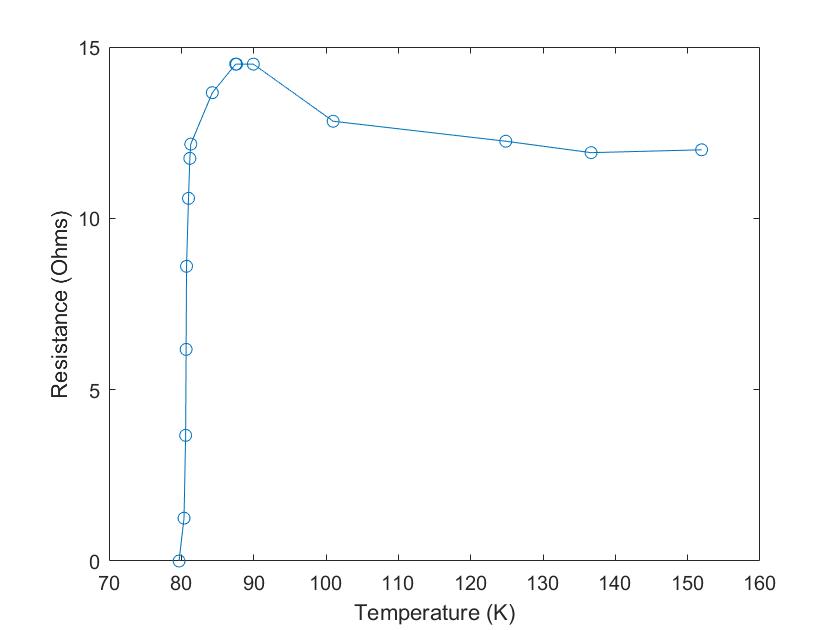
As expected the resistance of the superconductor went to zero as we moved close to the temperature of the liquid nitrogen.
The setup was pretty easy. James got these cool little High-Temp Superconductors with little pads on them. He soldered up a four terminal resistance measurement, and he epoxied it all to an aluminum block – just one we had laying around. On the other side of the block, we epoxied a thermistor that can work over temperature ranges 4K – 400K. We put the whole set up in a plastic box that we had 3D printed. (The box was not printed for this and it was something that we just had laying around.) Then we put the entire setup in a second container. We poured in liquid nitrogen (thank you Chem department) and then monitored both resistances as the temperature heated up as the liquid nitrogen boiled away.
There is always a learning curve:
The students really struggled with understand what we were measuring. We measuring the voltage drop across the superconductor to determine resistance of the superconductor. But at the same time we were measuring the resistance of a thermistor to find out what the temperature was. I kept saying we want to show that the resistance goes to zero at T=Tc, but the thermistor’s resistance kept getting larger as the temperature went down. And the students were having trouble separating these things. It was kind of a mess. It’s the end of the semester. They are fried. I’m fried. Etc. The great thing about doing an experiment is you to keep breaking it down until it is all crystal clear.
I really like getting down to basics in the labs and not to brush things under the rug. I want to the students to understand both the logic of these experiments and how simple they can be. However, for this particular experiment it might have been better to use Logger Pro and automate the temperature collection. In addition to trying to understand what the crap is going on (as discussed above), converting the resistances into temperatures involved a couple of steps (calibration curve + interpolation) – which could have been a lab in itself. It might be good to have it automated.
In the end, we didn’t talk about the superconductivity as much as I would have liked. But they saw the transition. 🙂 And they saw how sudden it was.





Leave a Reply