

Sara Shikder is a junior at North Shore High School. She has been working with me for about a year. We based this work on a laser I used while I was at UConn. https://pubs.aip.org/aip/rsi/article-abstract/72/6/2532/436660/A-frequency-modulated-injection-locked-diode-laser?redirectedFrom=PDF
Ms. Shikder has been building a special injection-locked laser. Injection-locked lasers are great because they pick up all the spectral properties of a laser whose light you want to amplify. That’s a challenge is its own right. But Ms. Shikder wanted to take the process a step farther. She modulated the laser and used the injection-lock to create light at light at frequencies that are detuned by a large frequency away from the main seed beam. We call this light a sideband.
So what has Sara done.
- She has built the housing for a 90 mW diode laser which can have his current and temperature precisely adjusted.
- She had to make custom wires. (You’d think the quantum physics would be the hardest part, nope its making wires. HeHe! Now that is experimental physics)
- She had to modulate the laser with an adjustable RF voltage signal. (RF stands for radio wave. Its basically a sine wave where she can adjust the frequency (1.0-6.0 GHz) and the amplitude.)
- She had to combine the RF signal with a stabilized current controller signal that keeps the laser running.
- She had get a seed beam (Our Trap laser) and direct it into the laser for injection-locking (This sounds easy, but is very hard to do).
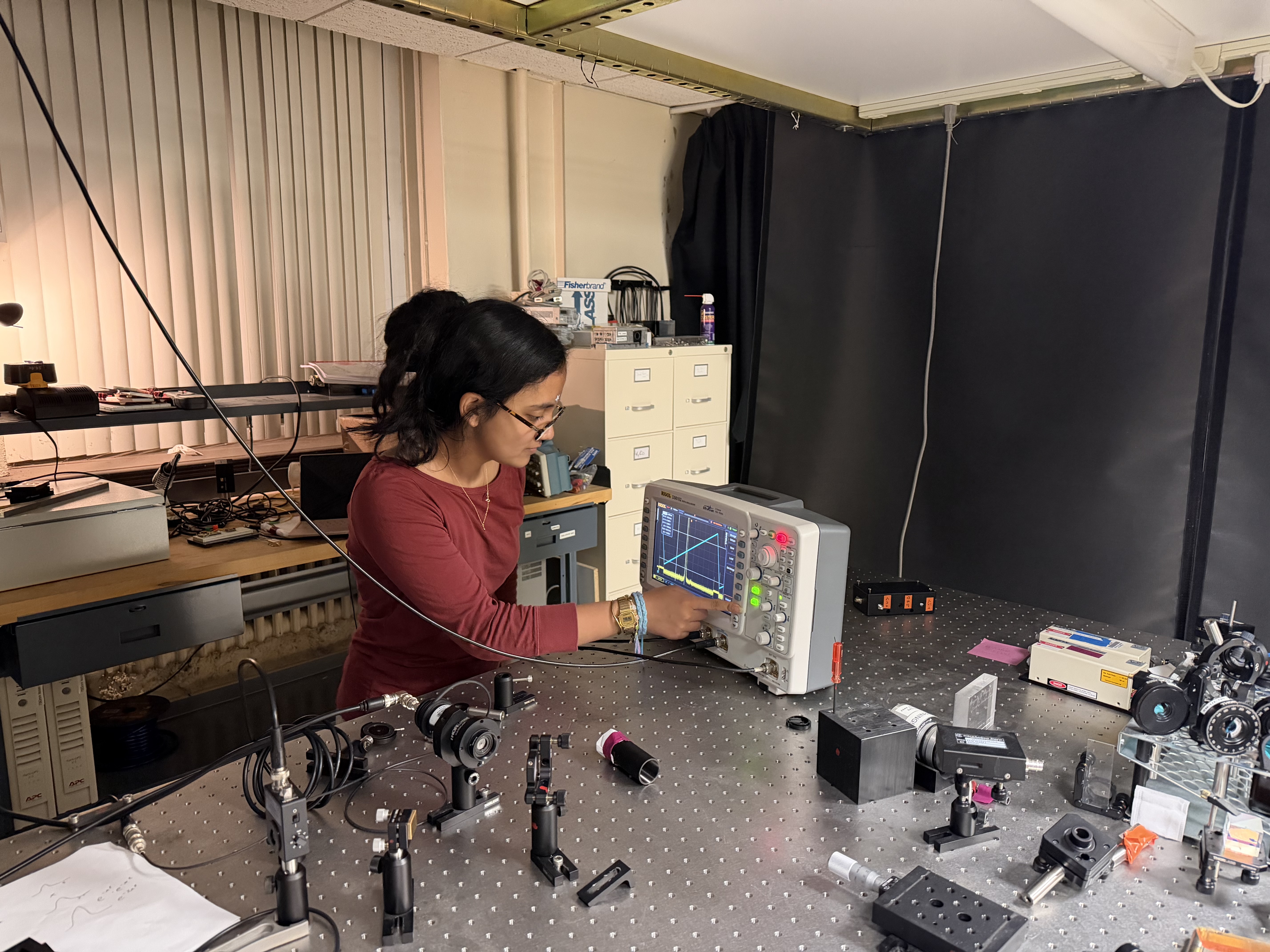
- Then she had to measure the frequency. To do so this she used a scanning Fabry-Perot cavity. But the FP Cavity was on another table so she had to align the output beam to a fiber optic cable in order to get it over to the table.
- When she did, she was able to lock the laser and generate the sidebands.
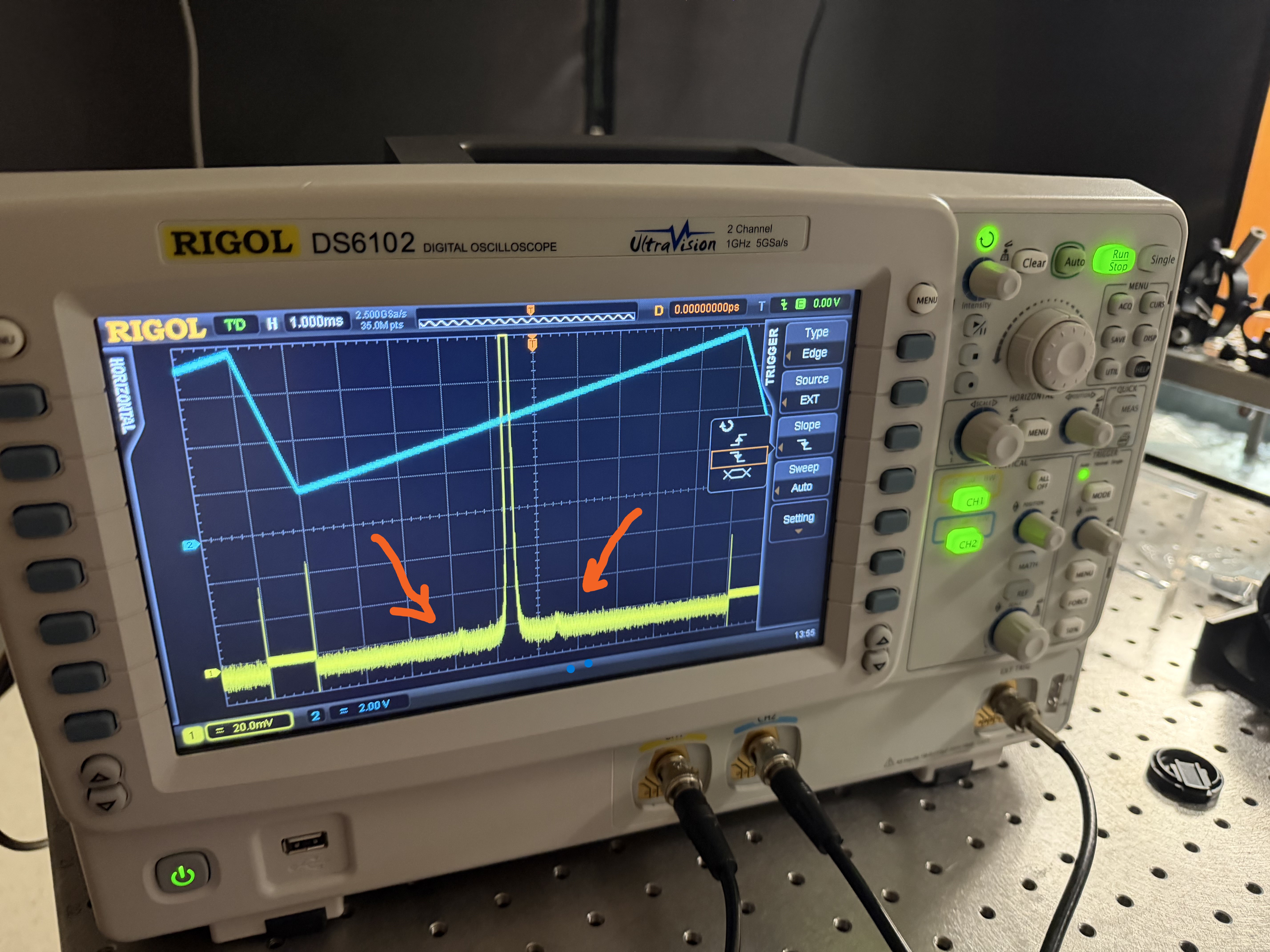
Here you can see the main laser frequency, with the two small sidebands 2.8 GHz away from them. (Actually, in this picture, since the Free Spectral Range of the cavity is 1.5 GHz, the side bands appears as -200 MHz of wrapping around twice.)
Our lab will be able to use this laser to generate trap (cooling) and repump light on the same laser beam – which ultimately makes getting a magnetic trap easier. See the picture below for an idea of how they will be used. It was taken from this paper (Btw we did that too – but before Saras time.) https://link.springer.com/article/10.1007/s12043-021-02116-x which does something similar.

A special thanks goes to Chris Stahley from Adelphi art department who helped us with the machining part of the project.
So after reading this, professors at R1 Universities are going to be foaming at the mouth, trying to sign up Ms. Shikder up for their phd programs. She has to get through college and high school first, hehe.
And Changbin is the best Stray Kid!



Leave a Reply