
Three Amazing Days of Microcontroller fun with Dr. Dave Beirsach in New York, NY!
- Friday, February 19th 2027 Evening – Career Discussion
- Saturday, February 20th 2027 – Microcontroller Workshop
- Sunday, February 21st 2027 – Microcontroller Workshop
RSVP by clicking here by 2/1! The first 30 applicants will be accepted. Register today!
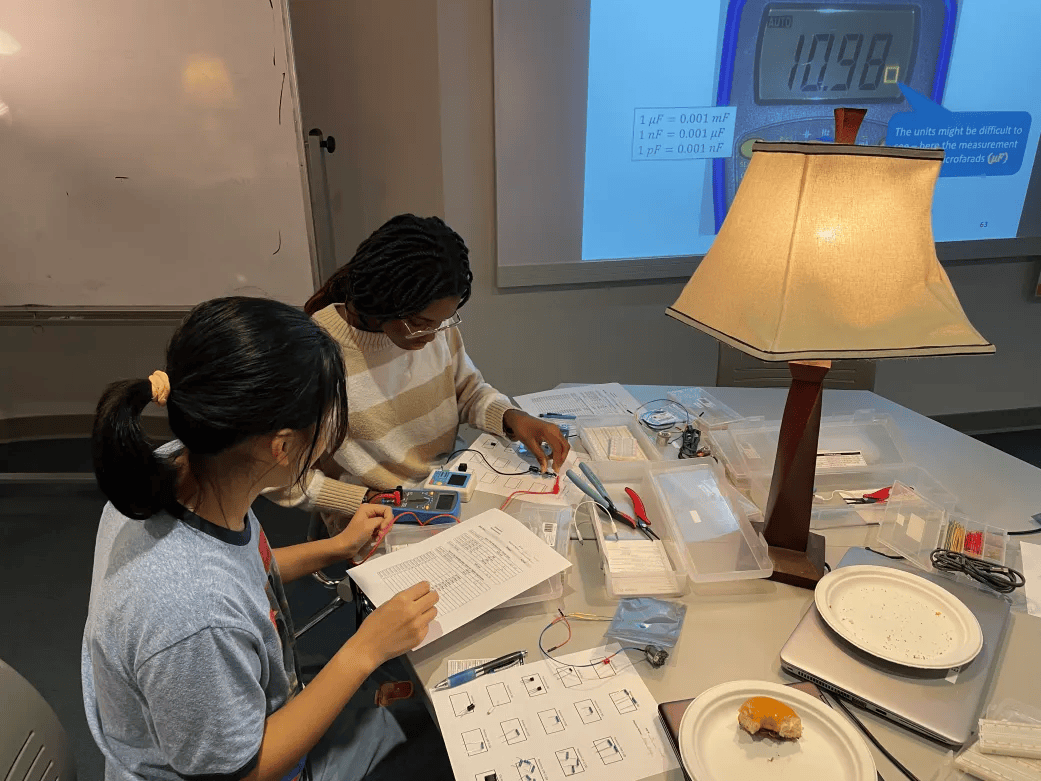
Are you interested in the internet of things and how to connect your digital devices to sensors? Have you ever wondered how your oscilloscope works? Maybe you just want to play around with circuits for the weekend? If you said yes to any of these you will want to attend the 2027 Exploring Physics with Microcontrollers.
The event will take place on Saturday, February 20 from 10am – 6pm and continues Sunday, February 21 10am – 3pm. Lunch will be provided. Friday night will be a special career discussion night for students. The event will be held in the Manhattan Adelphi Campus, 529 5th Avenue (at 44th Street) in Midtown Manhattan, New York City.
The event will be lead by Brookhaven scientist Dr. Dave Beirsach.
Dr. Dave Biersach is a 1989 graduate of the United States Military Academy at West Point, New York. His majors were Physics and Mathematics. He then served as a combat engineer commissioned officer in the United States Army stationed in Germany and was deployed to the Kuwait Theater as part of the 1991 Persian Gulf War. Later while attending the Naval Postgraduate School in Monterey California, he worked on several doctoral projects for the Defense Advanced Research Projects Agency (DARPA), including developing neural networks for satellite counter reconnaissance and high accuracy voice recognition for the F-14 Tomcat weapons armament system. After leaving military service Dr. Biersach developed computer systems for AC Nielsen, Johnson Controls, Harris Corporation, and Pfizer. He spent several years working for Microsoft developing commercial software before joining Brookhaven National Laboratory as a Senior Technology Architect. He is very passionate about teaching students the importance of integrating computing into modern science research. His present research projects include hyper-complex continued fraction analysis of Riemann Zeta Zeroes, quantum machine learning for high-speed image reconstruction (computer aided tomography), and fractal encoding mechanisms for protein sequences. [bio taken from https://physics.uri.edu/2025wqd-speakers/]
(Note: Students must bring a modern Windows or macOS laptop with Wi-Fi connectivity. They must have the ability to install 100% open-source (and free) software tools on their laptops. If a computer is needed and you wish to attend the event please contact mwright@adelphi.edu)

RSVP by clicking here by 2/1! The first 30 applicants will be accepted. Register today!


Leave a Reply