
In this page, we will talk about how the Fourier series is a complete orthogonal system.
Math Refresh
I am going to try to keep the math simple. Instead of doing lots of trig substitutions I am going to work with a simple set of math operations when I am going to be using over and over again. The first is an integral and the second is the Euler equation. Remember even and odd are special case functions that behave in the following way: an even function is f(x) = f(-x) and an odd on is f(-x) = -f(x).
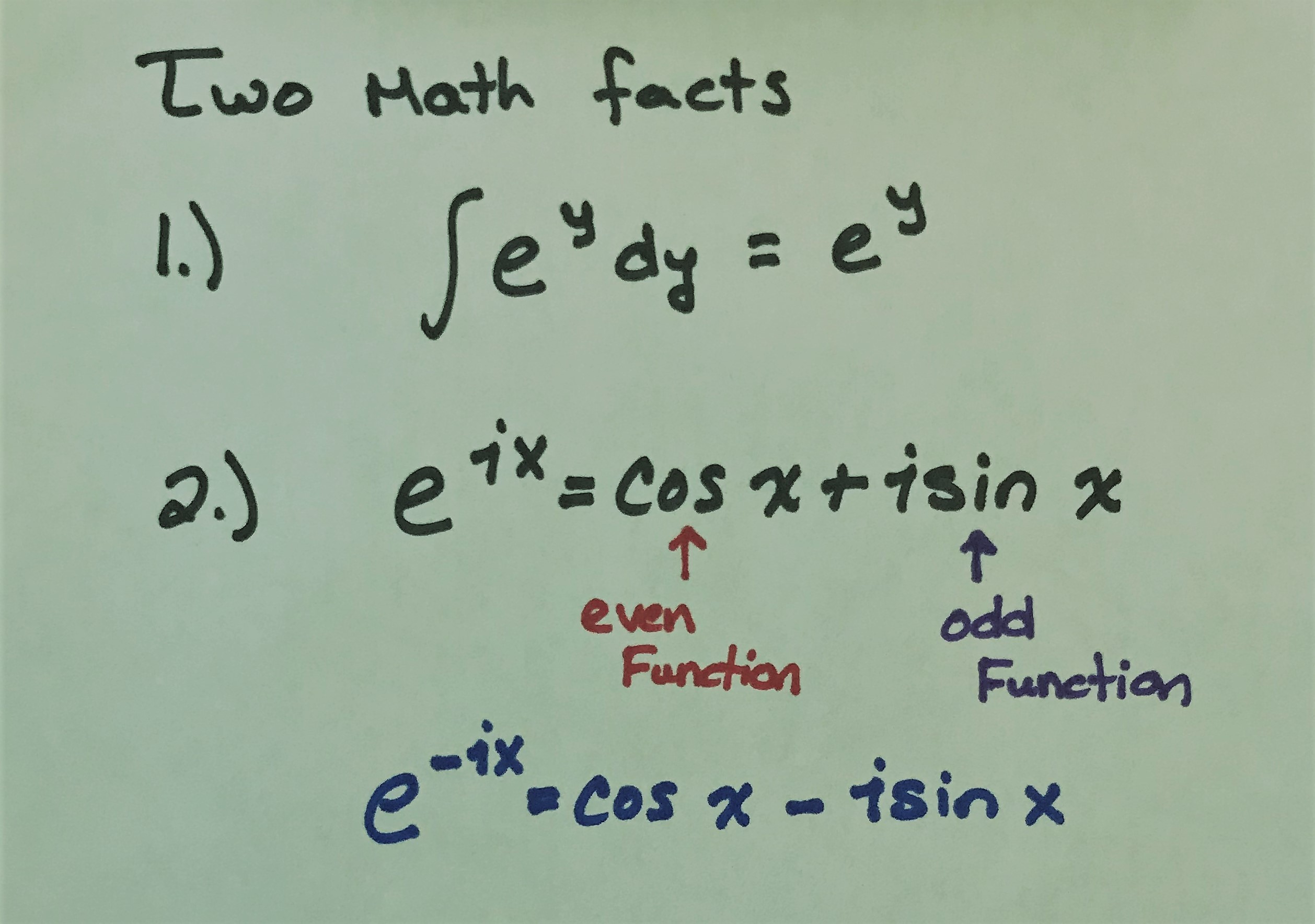
With fact 2, we can rearrange this into descriptions for sin (x) and cos (x) by just doing some arithmetic.

Task #3 Prove the sin relationship on the right of this figure.
Fourier series
Let’s start with an assumption, the Fourier Series is a complete and orthogonal function from 0 to 2pi. This means that any integralable function from 0 to 2pi can be expressed as a Fourier Series expansion (ie, get all the a0, an, bns).
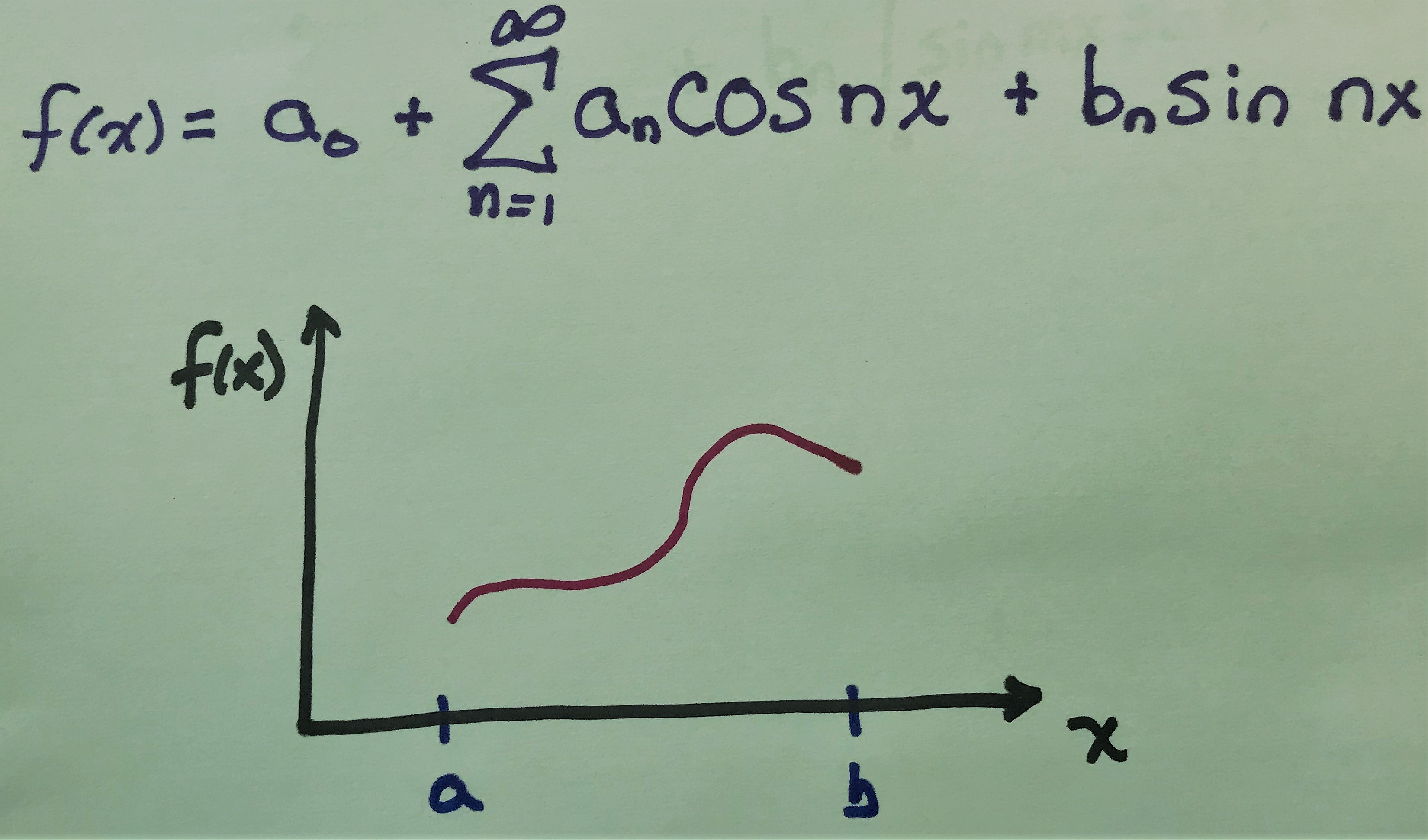
This is good but who cares? I could never solve that equation because there is an infinity there. So how in the crap could I find those values? Its time to use the orthogonally of these functions as a weapon! A sum squashing weapon! The “Trick” is to multiply by sin (mx) and integrate to isolate an equation for the bn terms.
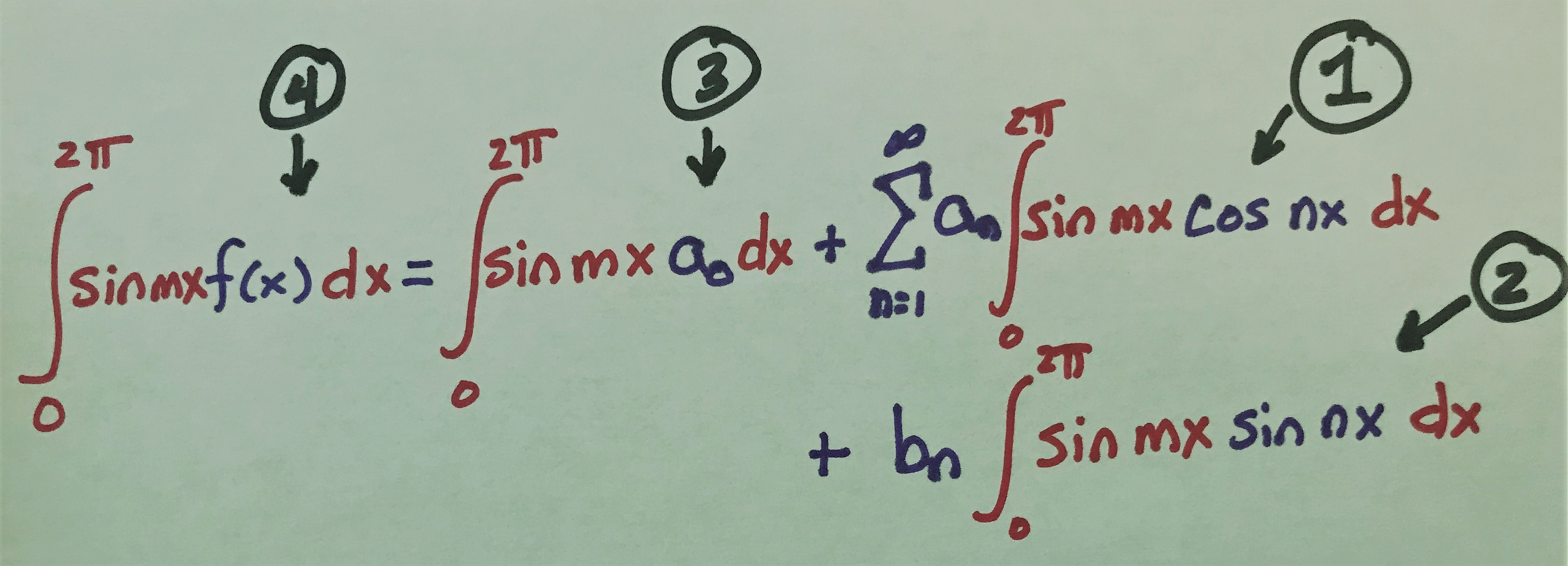
Now there is soooo much to unpack here so let’s do it integral by integral. I am going to start with integral (1) first.
Let’s use the math tricks we know. Plug our Euler’s equation values for sin and cos, this gives us:

Now multiply out those terms. In the USA the method is called FOIL, yielding:

Now before we do any integrals here, what do we know about the terms m + n and m – n? Well m+n can only be a integer from 2 … infinity. Where as m-n is an integer that could be negative, positive and zero.

So let’s consider a simple integral. Alpha is an integer. You pull out the integral machine and start integrating. You get zero, provided that alpha isn’t zero. So all the integrals above are zero except when m-n is zero or m = n.

When m=n or alpha is zero:
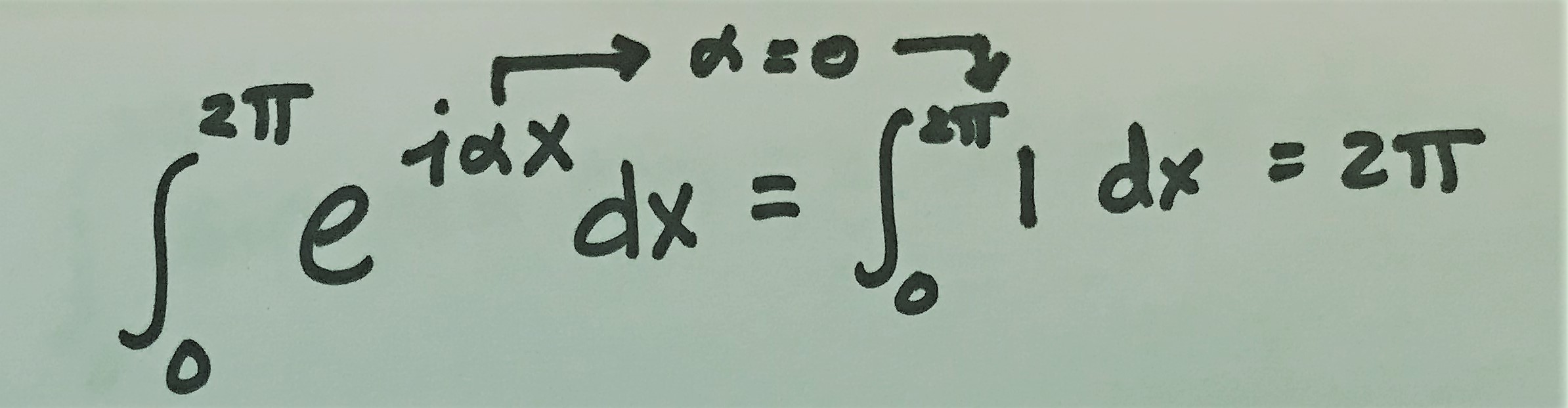
Thus leading to the following:

Applying what we learned to the original integral gives us:

Which means integral (1) reduces to:
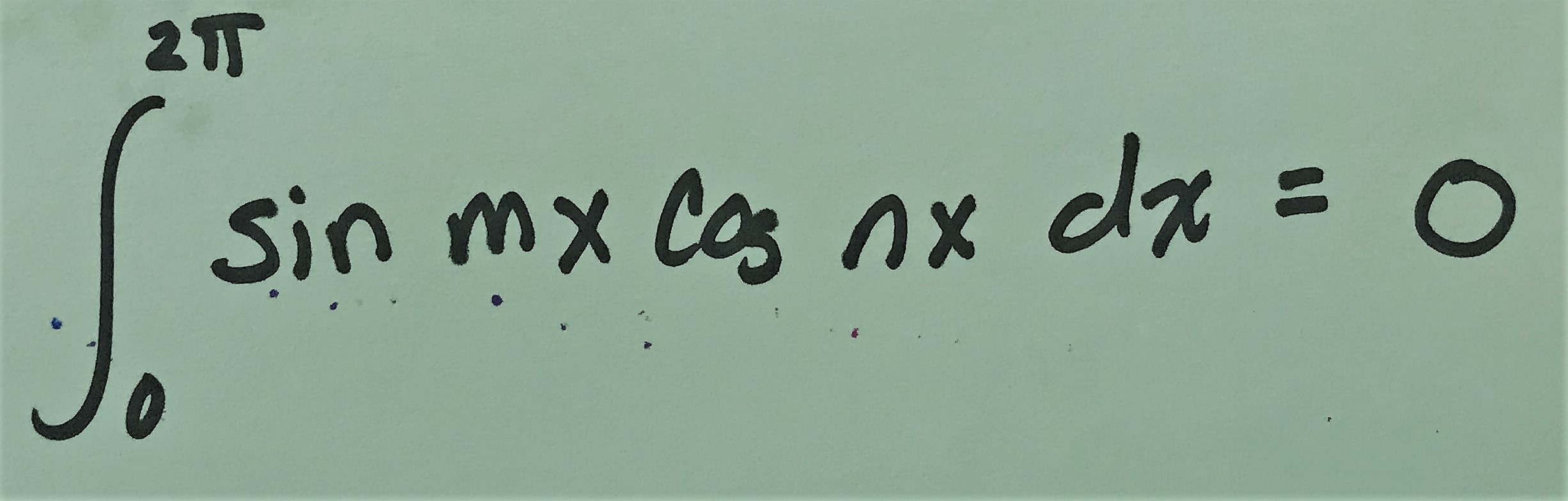
Here the 2pi terms cancel. When you do the other integral, integral (2) they will not. Task #4 show the following:
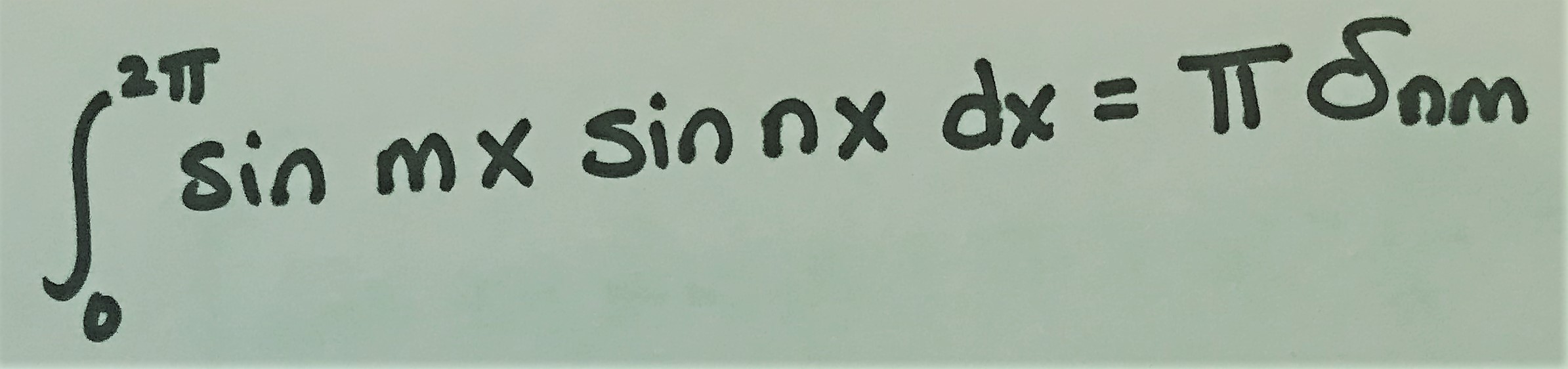
And then there is integral #3 which is (comparatively easy to prove):
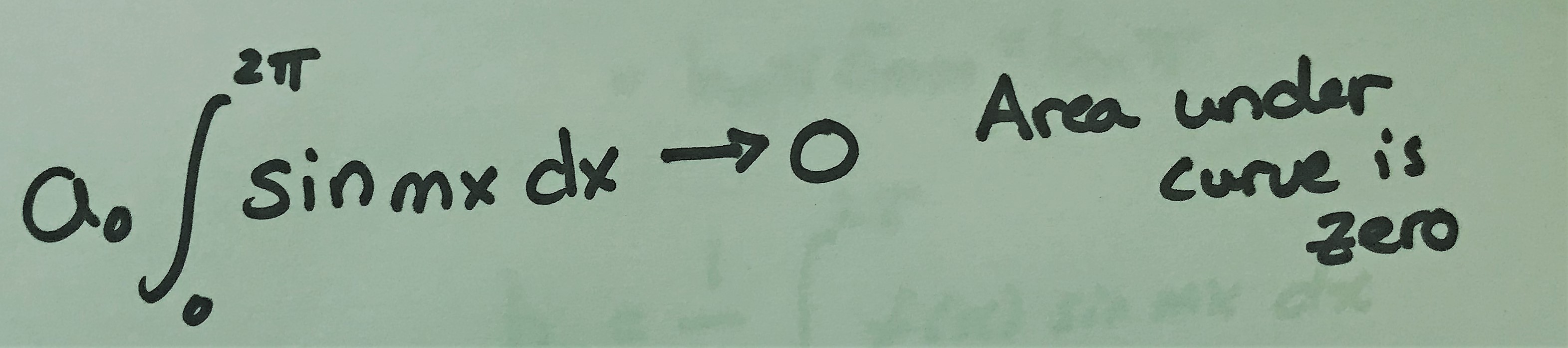
Bringing integrals (1), (2) and (3) together gives the following:

We have two 0 and a sum over a delta. When we do that sum, we will use the delta to SQUASH IT! Consider, you write out the sum. There is only one delta that is 1. That happens when n = m. Next you can just solve for the bm terms. SUMMATION GONE!
You can do this for the other constants as well, yieldings:

Task #5 prove a_m and a_0, in a step wise manner similar to this document.