
Let’s say your application has multiple MCP 4725 DACs in it. That is fine! Its a good 12-bit chip. But you need to be careful. You need to change the address on the chirp. Check out the following page: https://protosupplies.com/product/mcp4725-12-bit-dac-module/
Notice the section on the address.
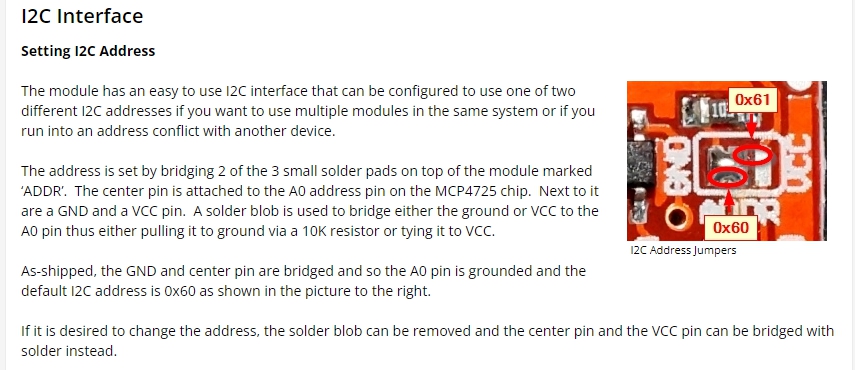
Then you need to set up it up and run the following code, which I took from the following site (https://learn.adafruit.com/scanning-i2c-addresses/circuitpython):
# SPDX-FileCopyrightText: 2017 Limor Fried for Adafruit Industries

#

# SPDX-License-Identifier: MIT


# pylint: disable=broad-except, eval-used, unused-import


"""CircuitPython I2C Device Address Scan"""

import time

import board

import busio


# List of potential I2C busses

ALL_I2C = ("board.I2C()", "board.STEMMA_I2C()", "busio.I2C(board.GP1, board.GP0)")


# Determine which busses are valid

found_i2c = []

for name in ALL_I2C:

    try:

        print("Checking {}...".format(name), end="")

        bus = eval(name)

        bus.unlock()

        found_i2c.append((name, bus))

        print("ADDED.")

    except Exception as e:

        print("SKIPPED:", e)


# Scan valid busses

if len(found_i2c):

    print("-" * 40)

    print("I2C SCAN")

    print("-" * 40)

    while True:

        for bus_info in found_i2c:

            name = bus_info[0]

            bus = bus_info[1]


            while not bus.try_lock():

                pass


            print(

                name,

                "addresses found:",

                [hex(device_address) for device_address in bus.scan()],

            )


            bus.unlock()


        time.sleep(2)

else:

    print("No valid I2C bus found.")
This is what my circuit looked like:

And here is the code I used to address each DAC:
import board

import busio

import adafruit_mcp4725


# # Initialize I2C

i2c = busio.I2C(scl=board.GP5, sda=board.GP4, frequency=100000)  # Increased frequency for stability


# Initialize MCP4725 DAC

dac1 = adafruit_mcp4725.MCP4725(i2c, address=0x60)

dac2 = adafruit_mcp4725.MCP4725(i2c, address=0x61)


dac1.raw_value = 2000

dac2.raw_value = 1000