
The Cartesian unit vectors are an example of a simple complete Orthogonal system. Let’s dive in.
Let’s remember how a vector is defined:

An arbitrary vector can have components in the x-, y-, and z-directions. We can find the total vector but adding up the components multiplied by the unit vector in the appropriate direction.
Why Orthogonal?
The unit vectors are orthogonal because they obey this nice simple relationship, if you take the dot product between i-hat and i-hat you get one where i-hat and j-hat you get 0. This is because they are perpendicular. People often associate “Perpendicular” with ” Orthogonally”. I am not a big fan of this. Orthogonally is more than just perpendicular, but it does get the conversation/ideas going.

Now to think about it in a slightly different way, image rewriting the unit vectors in the following notation:
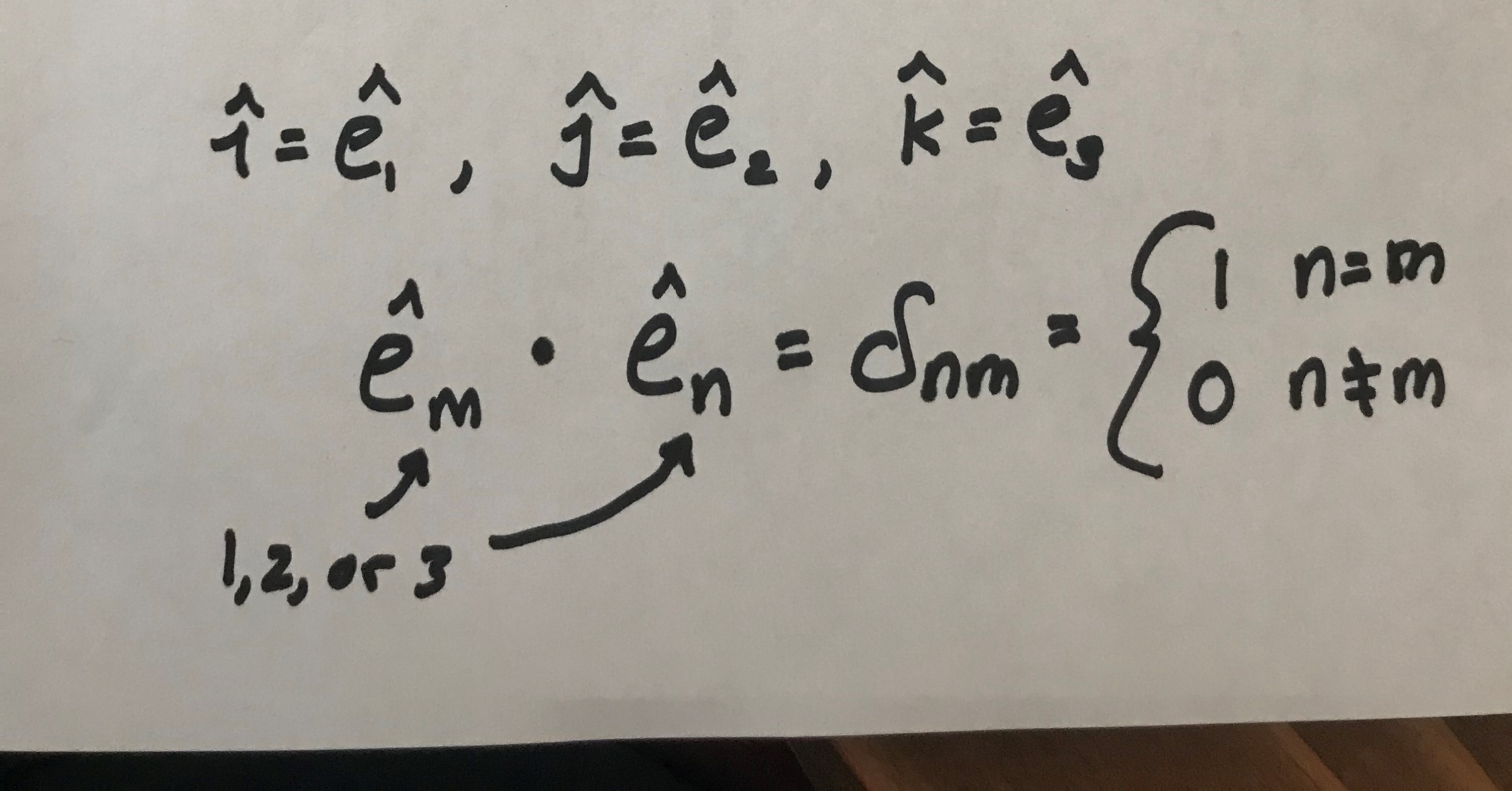
We know that i-hat dot i-hat is one right? So e_1 dot e_1 is the same thing, it is also equal to one. Where as e_1 and e_2 are different (i-hat and j-hat) so there you get zero. This leads us to something you see all the time with orthogonal systems, Kronecker delta! When you take an inner product (here dot product) you get one when they are the same and zero otherwise.
This only true when the unit vectors are perpendicular. For example, in general r-hat dot i-hat doesn’t have to equal 1 or 0.
Why Complete?
We say it is complete because the set {i,j,k} covers the entire range of possibilities. There isn’t some hidden dimension out there that we are missing – at least in classical physics. When we write vector out as in the picture below, we have included all of the information about the vector in that sum.