
Towards a Physics Outreach Event for Shark Labs
By Evan Moore
1. INTRODUCTION
The Erector set is a STEM focused childrens toy by Meccano, on its own it is very simple, you have a motor and some pulleys and belts and you can make cars and such. My project is to make robots with the Erector set, then later use it in combination with an Arduino or Raspberry Pi to program and run them, and then finally develop a workshop teaching people how to build robots.
2. PROJECT
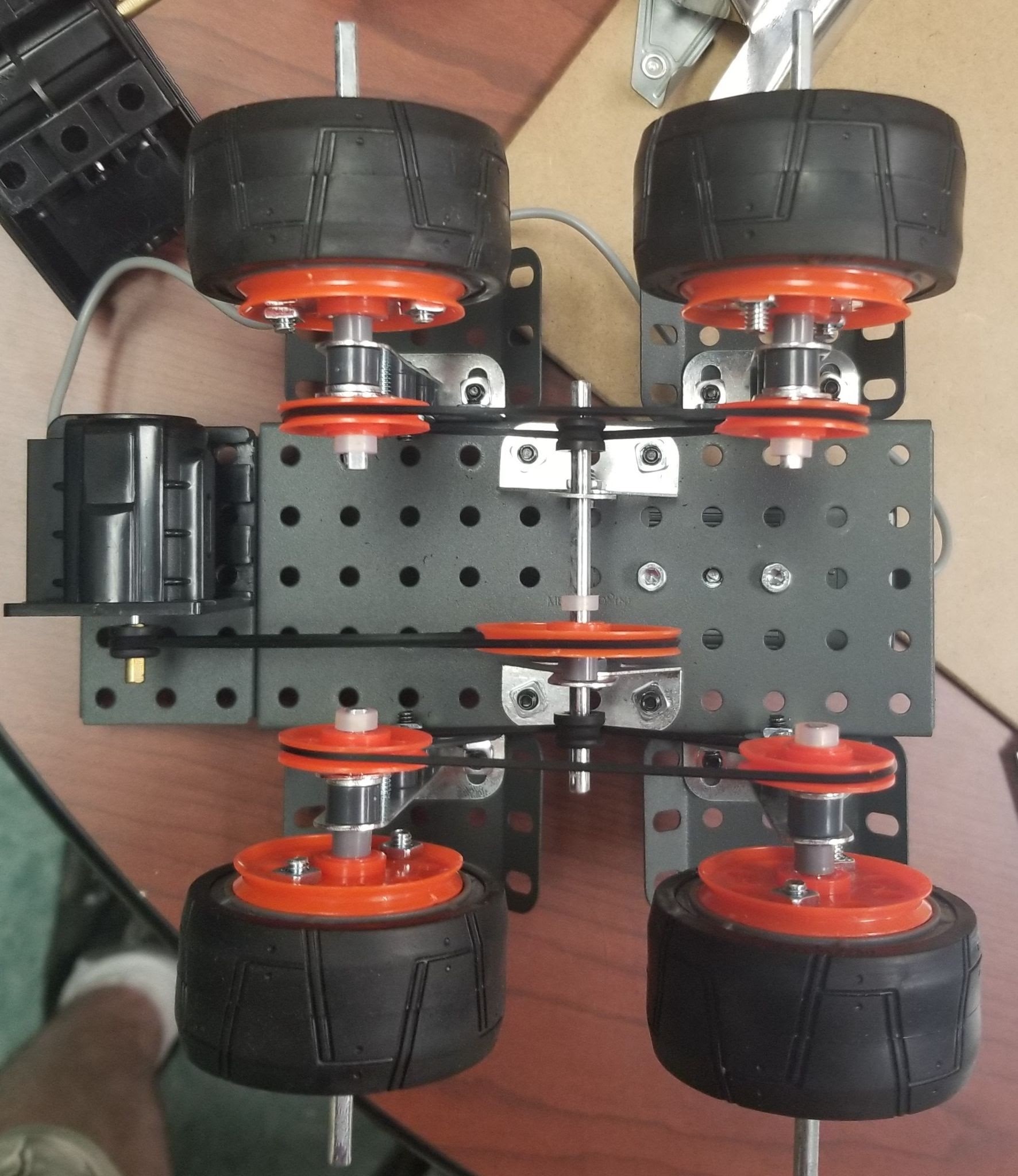
The first project was to build a car with the Erector set. To the left is the underside of the car. The car worked by sending power from the motor to a small rubber pulley which is connected to a large plastic pulley on the central axle of the car by a rubber belt, this increases the torque of the wheels. After that the power is transferred from the central axle to all the wheels on one side of the car using a triangular shaped belt which connects the central axle to the wheel axles, yet again increasing the torque. This in turn drives the wheels and moves the car forwards. The car has to have the torque increased significantly because the motor that runs it has a high rotation speed but low torque.
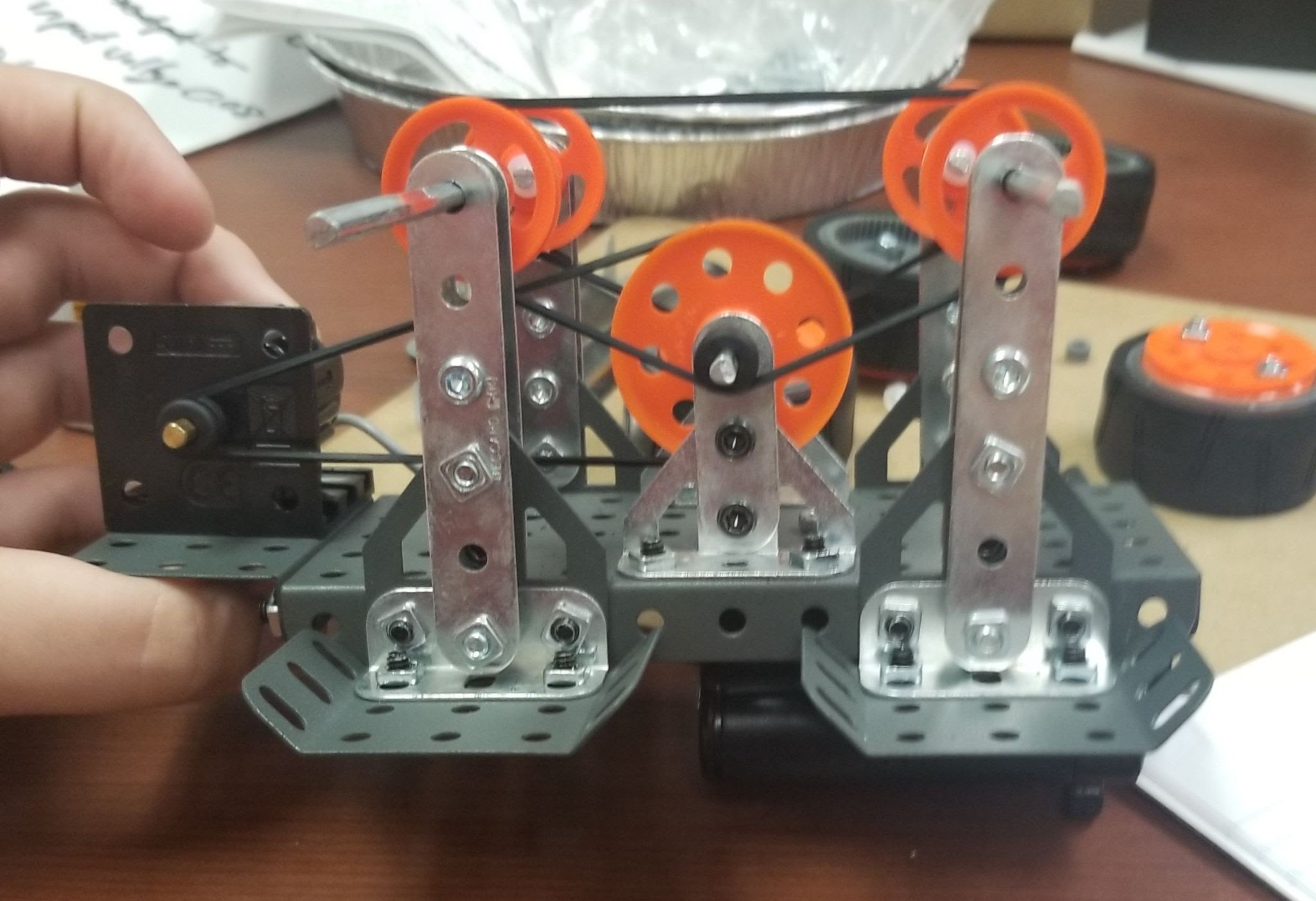
On the right you can see the triangular belt and how it works better. It was impossible to have the pulleys in a straight line and power the wheels as there would not be enough pressure on the central pulley. So in order to have constant pressure on the pulleys from the belts it was necessary to lower the wheel axles (as the central axle could not be raised without hitting the body of the car, and lowering the central axle would cause it to hit the ground before the wheels).
Another thing to note about the car is it’s lack of steering, this is due to the fact that in order to steer the car, two motors are needed. In a rack and pinion style steering system the car moves straight while the front wheels turn, and in a tank style steering system you need one side to move opposite from another in order to turn on the spot. Both types of steering require two sources of power simultaneously in order to work, currently without a method of switching motors on and off remotely there is no method of doing so.
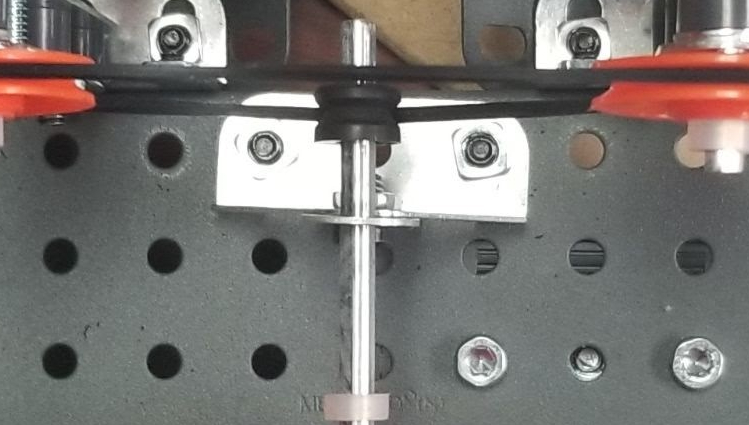
The car worked nicely for about 10 minutes, however the quality of its motion started degrading after that, and a problem occurred where when the car was set to go forwards, only the left side worked, and for the right side the opposite was true. The cause of this issue was never found, but one possible cause was that the rubber belts started to slip and frayed, as there were little pieces of rubber found on the body of the car around the pulleys. However after working on trying to figure out the problem for 30 minutes there was no definite cause in sight, so work on the car was considered finished. Below you can see the pieces of rubber that were noted to be seen on the car, note the small black flakes littering the chassis of the car.
3. MISSTEPS
Throughout building the car there were many small scale experiments that were run to see the feasibility of certain building techniques. One technique that was tried multiple times with failure each time was trying to transmit torque at 90 degrees like gears. Below is what the first experiment looked like. (note: no pictures were taken so here is a diagram of what it looked like.
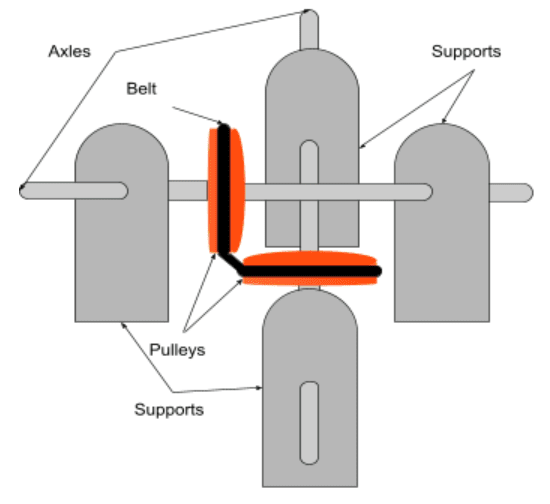
As shown there are two axles with a pulley on each at 90 degrees to each other and a belt between the two. Ideally if this would work if the left and right axle turns, then it would cause the up and down axle to turn equally. That however, did not happen. Instead the band would slip off after a few rotations instead of properly holding the belt in place. Along with that there were issues aligning the pulleys. After about 30 minutes of trying, the idea was scrapped.
The second attempt at transmitting torque at a 90 degree angle, used medium pulleys with rubber rings that made the pulley a wheel. two of them rubbed together and one pulley drove the other, the setup worked but there were issues with the connection between the two pulleys as the rubber frayed when the belts rubbed together, this led to material being lost from the wheel and led to more inconsistencies. While this setup worked, it worked inconsistently and the slightest bump made it stop working.
Another failure of the car was when the car was first finished, issues arose due to the fact that I had the triangular belt that drives the wheels inverted. This had the bonus of the car having a lower center of gravity, but also led to the immediate issue of the large pulley hitting the ground before the wheels. This was fixed by flipping the triangular belt and ending up with the final design.
4. CONCLUSION
There were a few issues I had with the car and the Erector set in general. First, Because there were no gears, torque could not be transferred at 90 degrees reliably. This can possibly be fixed by 3D printing some gears. Also, The car’s complexity was very limited, you cannot make anything with two motors going in different directions, or at different times, which includes steering. We will explore additional options in the future.




Leave a Reply